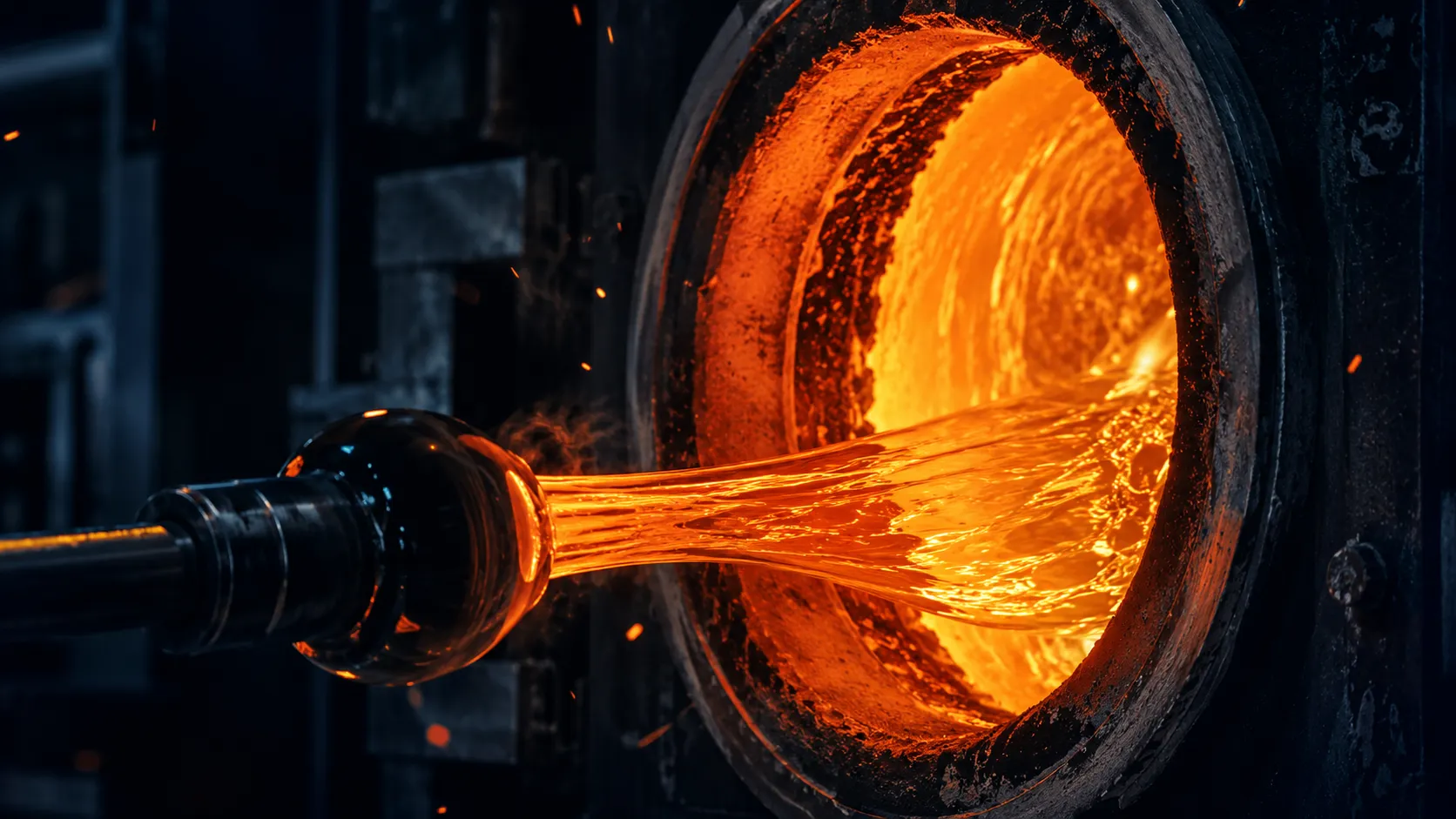

Up to 370 Tonnes a Day.
One Critical Furnace.
One question, not answers
The study began with Zignago's operations, prioritised what to protect — the flint food & beverage family — then framed one question.
What could stop Furnace 14 — and what would it cost Zignago to keep serving its customers?
A priority risk for the flint line — and what protecting it costs
A method aligned with ISO 22301
A methodology aligned with ISO 22301 and the BCM lifecycle (BCI Good Practice): policy & programme, embedding, analysis, design, implementation and validation — with risk financing added from enterprise risk management (ISO 31000).
for one critical asset.
lifecycle
RA + BIA
strategy
BCP
testing
A B2B glassmaker that never stops melting
Zignago is a listed glassmaker (~€596M group, FY2025) supplying other businesses — food, beverage and cosmetics. Its furnaces melt around the clock. At Fossalta, Furnace 14 runs the clear (flint) food & beverage line.

One site, one furnace — on purpose
The scope was kept deliberately narrow — that is what makes the answer clear and actionable.
- Fossalta di Portogruaro site
- Furnace 14
- Utilities — gas, power, cooling
- Flint food & beverage family
- Other plants — full site assessment
- Market / financial risk
- Detailed environmental compliance
Loss figures that follow are scoped to Furnace 14 / the flint line. The ~€596M group figure is context for scale, not the exposure base. Empoli enters only as a limited external recovery resource — no full site assessment.
One ruler for every risk
A 1–5 scale across four impact criteria — Economic, Legal/regulatory/contractual, Reputational and Safety — plus an Operational lens added for a production asset.
Furnace 14 — a critical concentration
The flint food & beverage family is the working prioritisation — to be validated with management (first Business Impact Analysis step, ISO 22317); Furnace 14 is its single critical resource — up to 370 t/day. Because furnaces are colour-dedicated, that output cannot simply shift elsewhere, and spare flint capacity is limited.
+ power (self-gen)
Within this study's scope, Furnace 14 is a critical concentration for the flint food & beverage family.
Different triggers, one result — the furnace stops
A semi-quantitative assessment — ordinal P × I scoring, plotted on a heat map.
- 1Gas supply — highest-scoring on the register
- 2Fire — most destructive; furnace hall is a high fire/explosion environment
- 3Flood — the site sits in a mapped flood area
- 4Earthquake — seismic zone 3
- 5Cyber — may disable IT/MES (Manufacturing Execution System) and process controls
Eight risks ranked — and one trap
| Threat | Inherent (P×I) | Key control | Res. P | Res. I | Res. score | Band |
|---|---|---|---|---|---|---|
| Gas supply interruption | 3×4=12 | Supply contract, no backup feed (weak) | 3 | 4 | 12 | High |
| Cyber (IT/MES systems) | 3×3=9 | Security (prevention → P) · backup & recovery (protection → I) | 2 | 3 | 6 | Medium |
| Flood | 2×4=8 | Site drainage / flood defences (protection → I) | 2 | 3 | 6 | Medium |
| Earthquake | 2×3=6 | Anti-seismic building standards (protection → I) | 2 | 2 | 4 | Low-Med |
| Cullet / raw material | 2×3=6 | Multi-source supply (prevention → P) | 1 | 3 | 3 | Low-Med |
| Forming-machine spares | 2×3=6 | Critical spares stock (protection → I) | 2 | 2 | 4 | Low-Med |
| Fire (furnace/hall) | 1×5=5 | Fire detection & suppression (protection → I) | 1 | 3 | 3 | Low-Med · see note |
| Key operators | 2×2=4 | Cross-training & procedures (prevention → P) | 1 | 2 | 2 | Low |
Fire is read on two cases: with protections effective the residual is Low-Med (I=3); the protection-failure tail — the MFL, I=5 — is a low-probability catastrophic case treated by severity override and transferred to insurance, not ranked by score.
Much is already mitigated — here's the gap
Months to rebuild, weeks of tolerance
Re-sourcing risk becomes material after 4 weeks (the MTPD). A furnace rebuild runs 5 months — so the RTO cannot be set on the asset.
Why the furnace is the constraint
| Activity | RTO |
|---|---|
| Utilities (gas / power) | 1 day |
| Melting — Furnace 14 CONSTRAINT | Restart (5 days) / cold repair (6 weeks) / full rebuild (5 months = asset restoration, not the RTO) |
| Forming | 1 day |
| Annealing / QC | 1 day |
| Palletizing / Warehouse | 1 day |
| Logistics | 1 day |
MBCO 30% ≈ 110 t/day = 30% of maximum capacity (an upper bound; 30% of actually committed volumes is lower) · timings assumed, to confirm.
Every day down has a price
~€330k/day
contribution margin
~€59k/day
No full backup — keep the service, finance the asset
A governance home that already exists
No new committee is needed. Four existing roles already cover oversight, sponsorship, execution and response.
From trigger to recovery — the plan in motion
Defined thresholds activate the plan — furnace trip / melt-temp breach, gas-supply loss, or fire / explosion alarm.
Incident team convenes (incident → crisis mgmt, ISO 22361); BC owner leads.
Protect people; thermally secure the furnace — hold the melt or controlled safe-shutdown — before alternate supply / curtailment; start stock shipments.
Customers, insurer, authorities.
Continuity bridge → MBCO (service); cold-repair contractor → full asset.
Annual drill — to surface what to fix, not confirm perfection — plus post-incident review.
The furnace is thermally secured first — limiting solidification damage protects the asset before the continuity bridge even starts.
Size the cover on the right loss
The loss scale: Amount Subject → MFL → PML → NLE. Use PML as the primary sizing basis; stress-test adequacy against the MFL — the worst case, a furnace-hall fire.
Insure what cannot be prevented
The fix costs a fraction of the loss
Three moves to make the risk manageable
- Put the repair contractor on call
- Validate clients & product lines, Empoli compatibility, stock & warehouse capacity
- Then size & approve the safety-stock buffer
- Alternative gas supply — feasibility & design
- Finalise curtailment; review fire protection
- Embed staff awareness & training
- Review & resize the insurance with the insurer, against the furnace-loss scenario
- Formalise & activate the steering team
- Run a first drill (validation)
Fact, benchmark, assumption, or derived — never invented
- Financials (FY2025 group)
- Furnace 14 specs
- Sites
- Hazard maps
- Governance
- Rebuild cost
- Glass price / tonne
- MTPD
- MBCO
- Recovery tiers
- Bridge sizing
- Programme cost
- Property loss (MFL/PML)
- Revenue exposure ~€330k/day
- Loss proxy ~€59k/day
- Cost-equivalent threshold
- Single-event loss ≈ €20M
Sources: Zignago FY2025 results & Sustainability Report 2025 · PGRA Alpi Orientali · insurance loss-estimation practice (Chubb, FM Global). The PML / MFL / NLE loss scale is that standard insurance framework (method), not a derived figure. Every figure is a public fact, a cited benchmark, a labelled assumption, or a derived output — none invented. Loss figures preliminary — to be refined by property survey & insurer quote.